Value Functions
Value functions map issue values to real numbers, and are the building
blocks of utility functions like
LinearAdditiveUtilityFunction (one value
function per issue) and GLAUtilityFunction
(one value function per group of issues). This page shows a picture of
every value function type, since a plotted curve or surface makes a shape
recognizable in a way an equation alone does not.
All classes described here live in negmas.preferences.value_fun and are
also importable directly from negmas. Single-issue functions
(subclasses of ~negmas.preferences.value_fun.BaseFun) map one issue’s
value to a number; multi-issue functions (subclasses of
~negmas.preferences.value_fun.BaseMultiFun) map a tuple of several
issues’ values to a number and are shown below as a heatmap over two
issues.
Single-issue functions
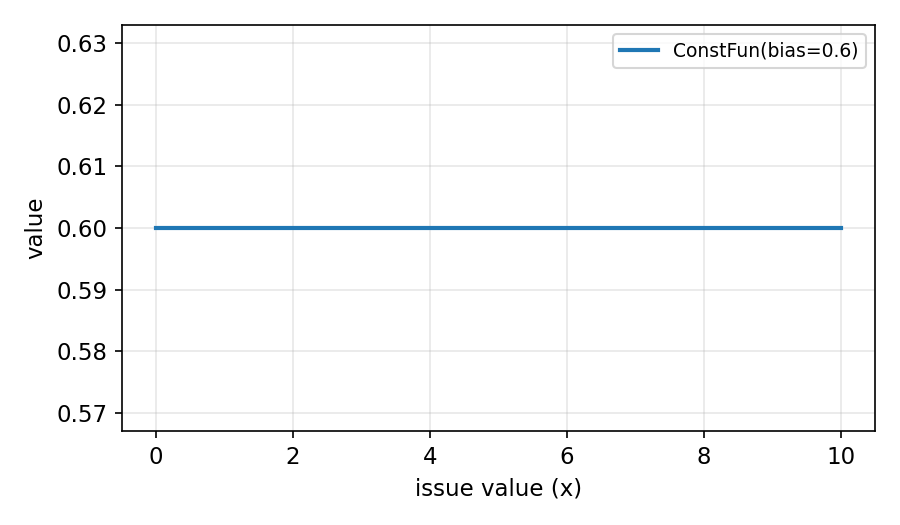
ConstFun
A constant: f(x) = bias, regardless of x.
from negmas.preferences.value_fun import ConstFun

f = ConstFun(bias=0.6)
IdentityFun
The identity: f(x) = x.

from negmas.preferences.value_fun import IdentityFun

f = IdentityFun()
AffineFun
An affine map: f(x) = slope * x + bias.

from negmas.preferences.value_fun import AffineFun

f = AffineFun(slope=-0.08, bias=1.0)
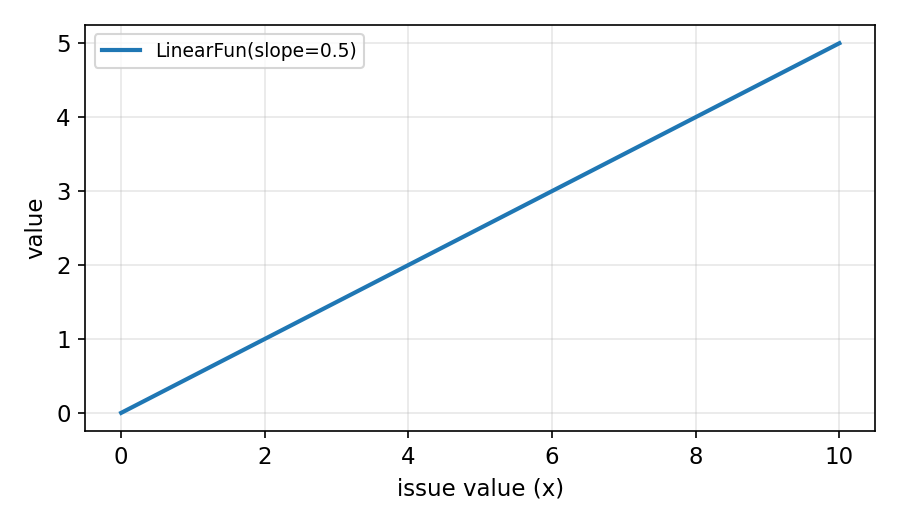
LinearFun
An affine map with no constant term: f(x) = slope * x. Equivalent to
AffineFun(slope=slope, bias=0).
from negmas.preferences.value_fun import LinearFun

f = LinearFun(slope=0.5)
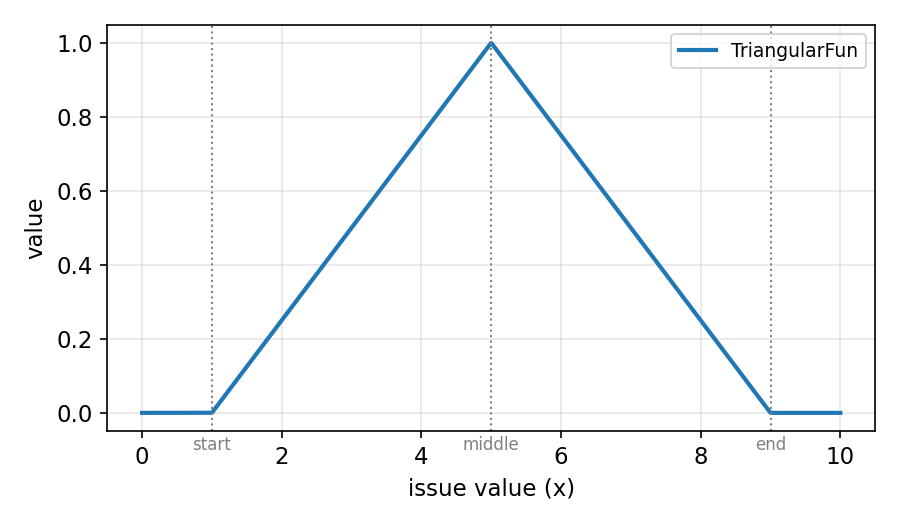
TriangularFun
A piecewise-linear tent: rises from bias at start to
bias + scale at middle, then falls back to bias at end.
from negmas.preferences.value_fun import TriangularFun

f = TriangularFun(start=1.0, middle=5.0, end=9.0)
TrapezoidalFun
A piecewise-linear function that rises from bias to bias + scale
over [start, rise_end], stays flat over [rise_end, fall_start], then
falls back to bias over [fall_start, end]. It generalizes
TriangularFun (a TrapezoidalFun with rise_end == fall_start is a
triangle) to have a plateau instead of a single peak.

from negmas.preferences.value_fun import TrapezoidalFun

f = TrapezoidalFun(start=1.0, rise_end=3.0, fall_start=7.0, end=9.0)
GaussianFun
A Gaussian bump: f(x) = bias + scale * exp(-(x - center)^2 / (2 * sigma^2)).
The center is a free parameter – it need not lie inside the issue’s
range. If it does, the function peaks there; if it doesn’t, the function is
simply monotonically decaying (or increasing, for a negative scale) over
whatever range the issue restricts it to.

from negmas.preferences.value_fun import GaussianFun

peak_in_range = GaussianFun(center=5.0, sigma=1.2)
decaying_from_an_edge = GaussianFun(center=-3.0, sigma=2.0)
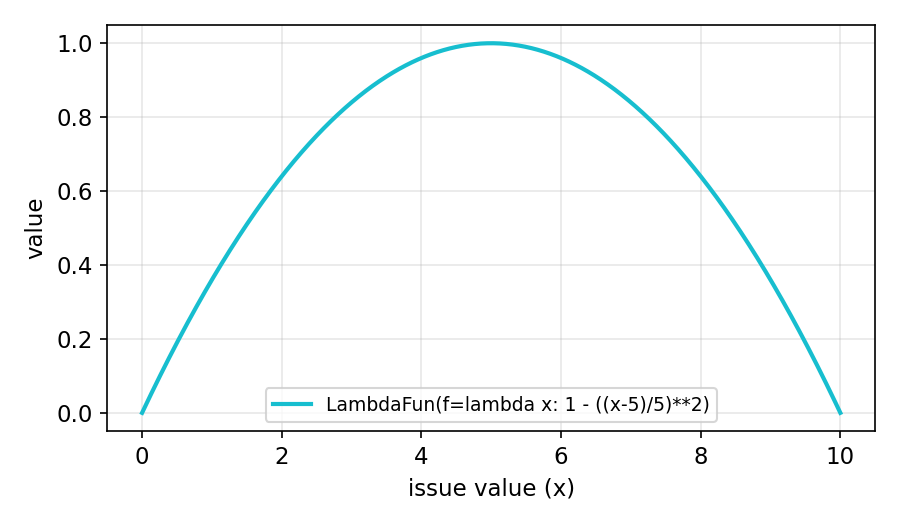
LambdaFun
Wraps an arbitrary callable: f(x) = g(x) + bias.
from negmas.preferences.value_fun import LambdaFun

f = LambdaFun(f=lambda x: 1.0 - ((x - 5.0) / 5.0) ** 2)
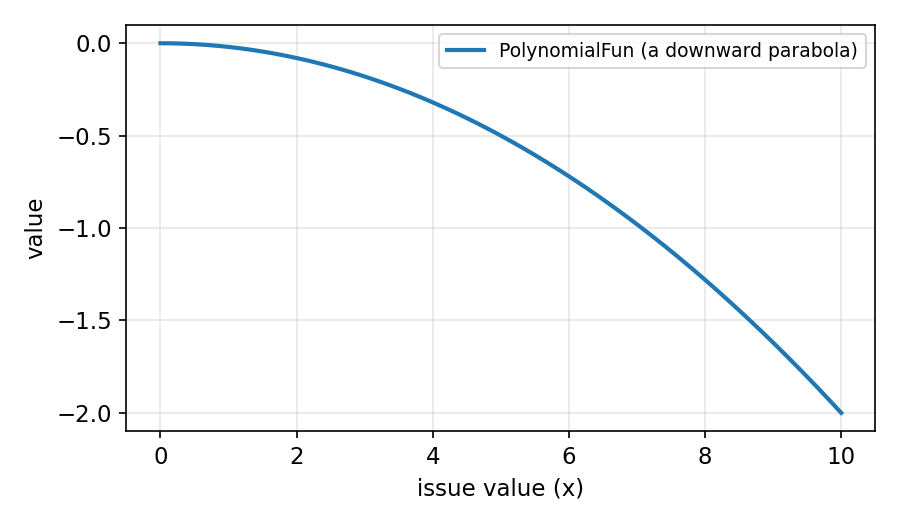
PolynomialFun
A general polynomial: f(x) = bias + sum(coefficients[k] * x^(k+1)).
from negmas.preferences.value_fun import PolynomialFun

f = PolynomialFun(coefficients=(0.0, -0.02))  # -0.02 * x^2
QuadraticFun
A specialized degree-2 polynomial: f(x) = a2*x^2 + a1*x + bias.

from negmas.preferences.value_fun import QuadraticFun

f = QuadraticFun(a2=0.04, a1=-0.4, bias=1.0)
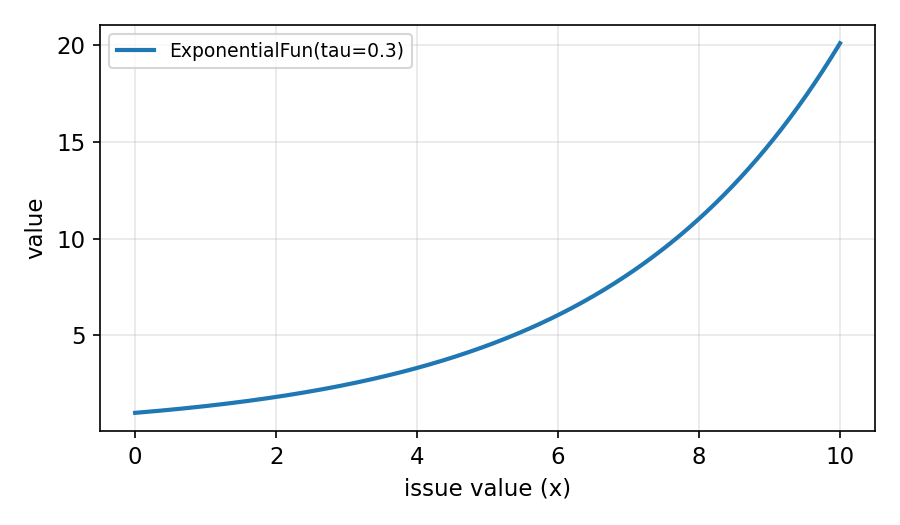
ExponentialFun
f(x) = base^(tau * x) + bias.
from negmas.preferences.value_fun import ExponentialFun
from math import e

f = ExponentialFun(tau=0.3, base=e)
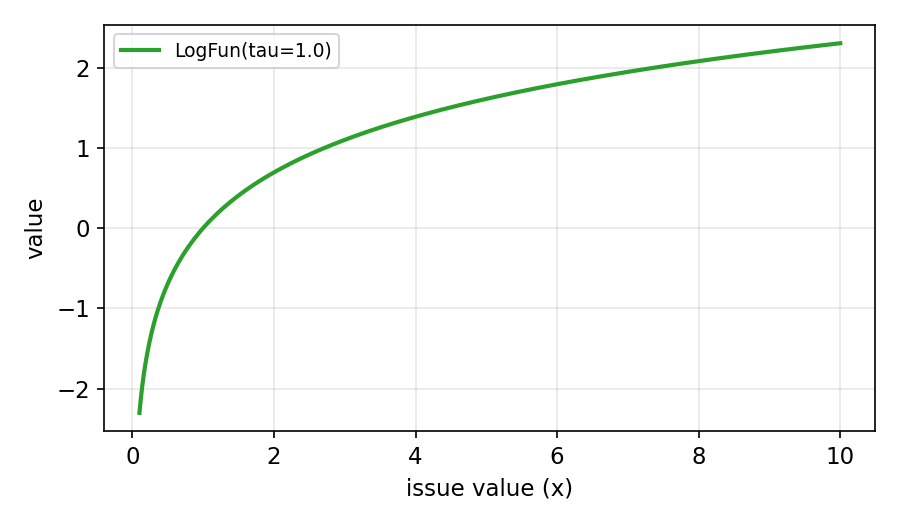
LogFun
f(x) = scale * log_base(tau * x) + bias. Requires tau * x > 0.
from negmas.preferences.value_fun import LogFun
from math import e

f = LogFun(tau=1.0, base=e)
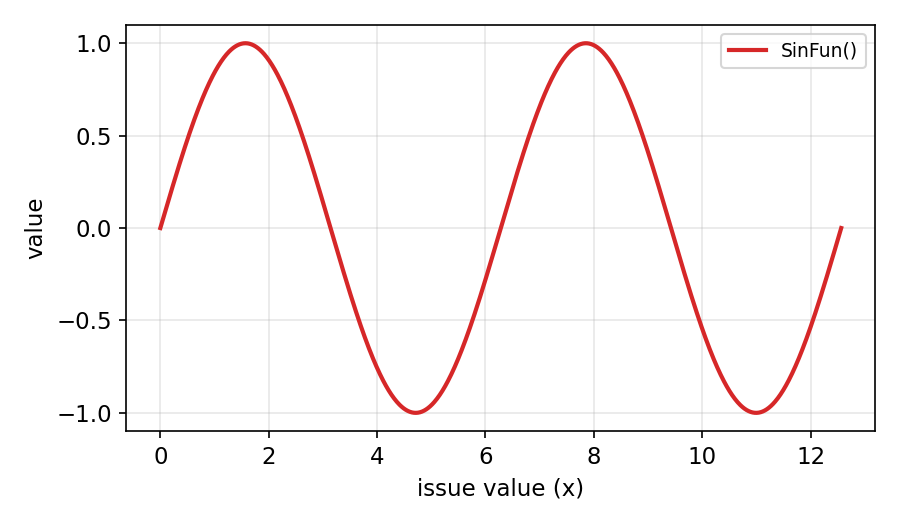
SinFun / CosFun
Sinusoidal functions: f(x) = amplitude * sin(multiplier*x + phase) + bias
(and the cosine equivalent).

from negmas.preferences.value_fun import SinFun, CosFun

f_sin = SinFun()
f_cos = CosFun()
TableFun
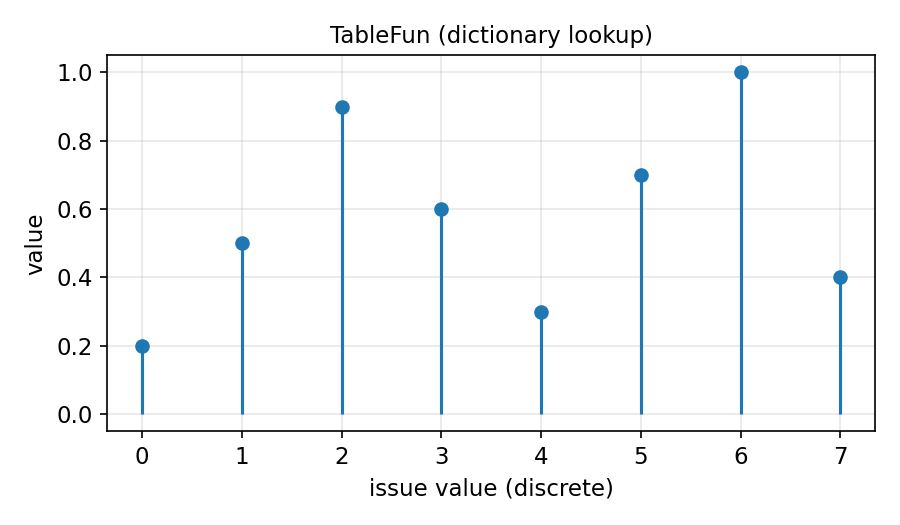
A dictionary lookup: maps discrete/categorical issue values to utilities. Unlike the other functions above, its domain is not continuous, so it is naturally shown as discrete points rather than a curve.
from negmas.preferences.value_fun import TableFun

f = TableFun(mapping={0: 0.2, 1: 0.5, 2: 0.9, 3: 0.6, ...})
AggregatingFun
A weighted sum of other BaseFun instances over the same issue:
f(x) = bias + sum(weight_i * fun_i(x)). This is the generic building
block for combining several shapes (including several GaussianFun or
TrapezoidalFun instances) into one value function, and is what
MultiModalGaussianFun and MultiModalTrapezoidalFun build on internally.
Passing normalize=True (and an issue) rescales the combination so
that its range over that issue is exactly [0, 1].
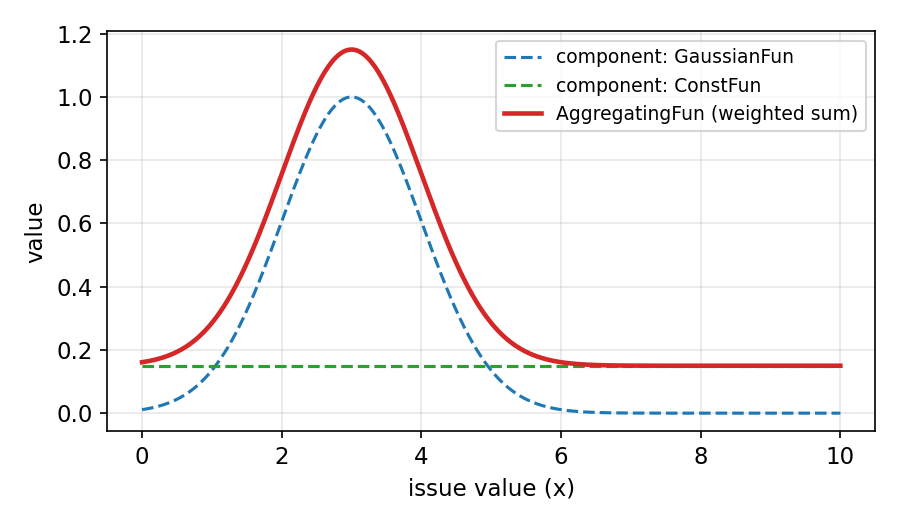
from negmas.preferences.value_fun import AggregatingFun, GaussianFun, ConstFun

combo = AggregatingFun(
    funs=(GaussianFun(center=3.0, sigma=1.0), ConstFun(bias=0.15)),
    weights=(1.0, 1.0),
)
BiasedFun
Wraps any BaseFun, adding a constant bias: f(x) = fun(x) + bias. Useful
for value function types that don’t already expose a bias parameter of
their own (e.g. IdentityFun, LinearFun). Like AggregatingFun, it
supports normalize=True (with an issue) to rescale its output to
[0, 1].

from negmas.preferences.value_fun import BiasedFun, IdentityFun
from negmas.outcomes import make_issue

issue = make_issue((0.0, 10.0), "x")
normalized_identity = BiasedFun(fun=IdentityFun(), normalize=True, issue=issue)
Multi-modal mixtures: MultiModalTrapezoidalFun / MultiModalGaussianFun
Build a multi-peak value function out of several trapezoids or Gaussians in
one call, taking each component’s parameters as a tuple (one entry per
component) plus a weights tuple, rather than requiring you to build the
equivalent AggregatingFun by hand.


from negmas.preferences.value_fun import MultiModalGaussianFun

two_peaks = MultiModalGaussianFun(
    centers=(2.0, 6.5), sigmas=(0.7, 1.3), weights=(1.0, 0.7)
)
Note
minmax for these two classes (and for AggregatingFun when it holds
more than one component) is approximate over continuous issues: a
mixture of several bumps need not have a closed-form extremum, so it is
found by dense grid sampling rather than analytically.
Multi-issue functions
Multi-issue functions map a tuple of issue values to a number, so they are
shown below as a heatmap over two issues (x on the horizontal axis,
y on the vertical axis).
LinearMultiFun / AffineMultiFun
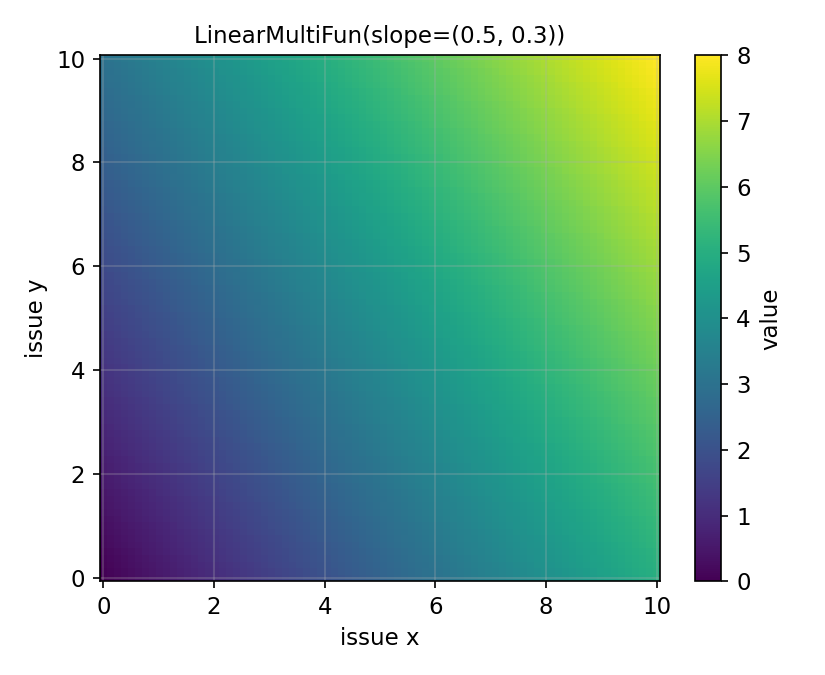
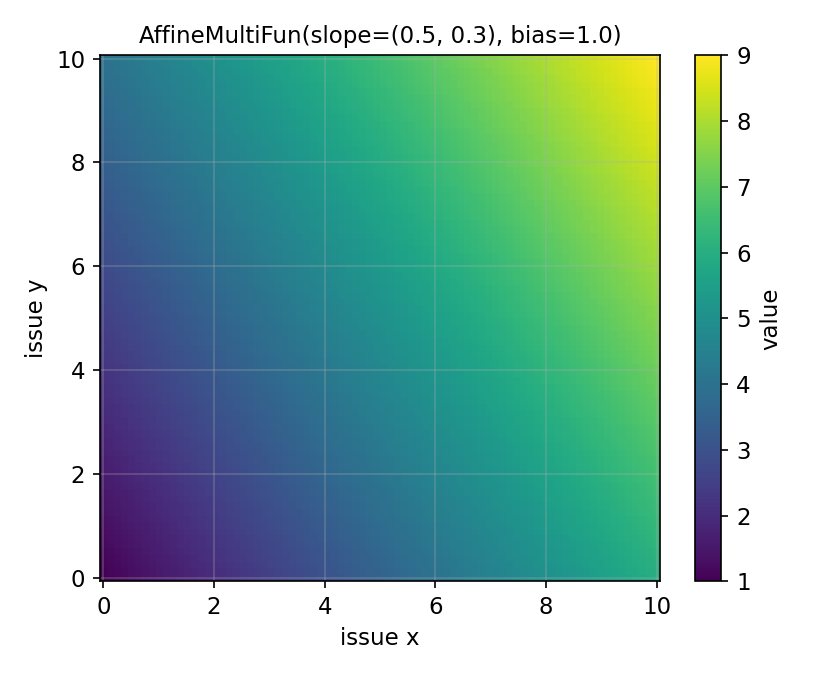
A weighted sum of issue values, with (AffineMultiFun) or without
(LinearMultiFun) a constant bias: f(x) = sum(slope[i] * x[i]) [+ bias].
from negmas.preferences.value_fun import LinearMultiFun, AffineMultiFun

f1 = LinearMultiFun(slope=(0.5, 0.3))
f2 = AffineMultiFun(slope=(0.5, 0.3), bias=1.0)
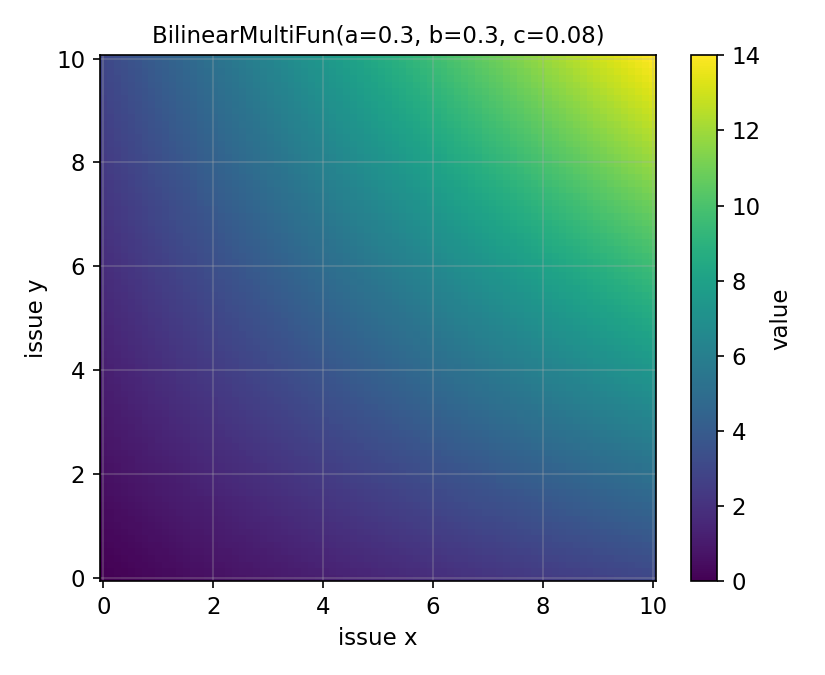
BilinearMultiFun
Two issues with an interaction term: f(x, y) = a*x + b*y + c*x*y + bias.
from negmas.preferences.value_fun import BilinearMultiFun

f = BilinearMultiFun(a=0.3, b=0.3, c=0.08)
QuadraticMultiFun
A full quadratic form: linear, squared, and pairwise-interaction terms for every issue.

from negmas.preferences.value_fun import QuadraticMultiFun

f = QuadraticMultiFun(
    linear=(1.0, 1.0), quadratic=(-0.1, -0.1), interactions=(0.0,)
)
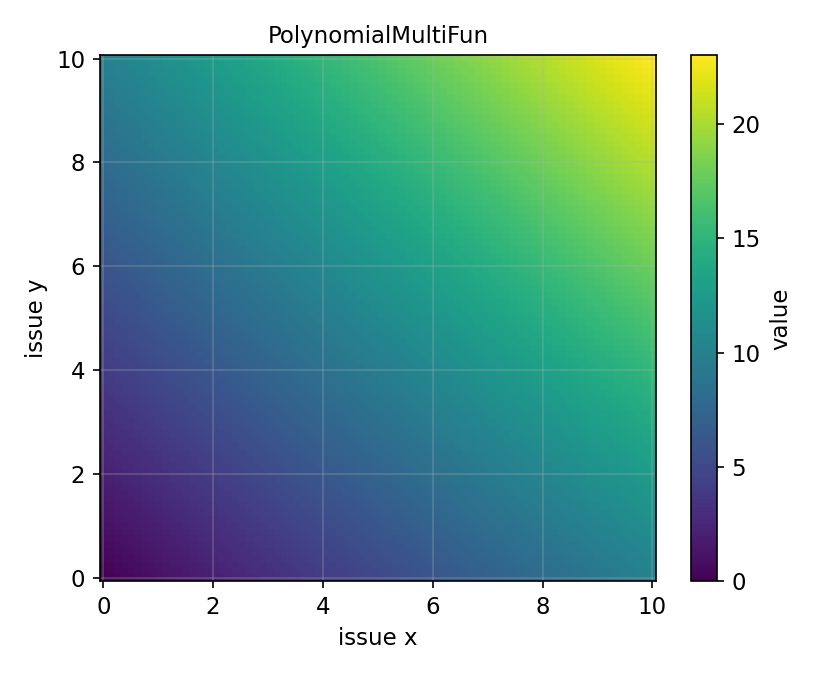
PolynomialMultiFun
A general multivariate polynomial: a sum of coefficient * prod(x[i]^power[i])
terms.
from negmas.preferences.value_fun import PolynomialMultiFun

f = PolynomialMultiFun(terms=((1.0, (1, 0)), (1.0, (0, 1)), (0.03, (1, 1))))
ProductMultiFun
A scaled product with per-issue powers: f(x) = scale * prod(x[i]^powers[i]) + bias.
With powers summing to 1 (as below) this is the Cobb-Douglas form common
in economics.

from negmas.preferences.value_fun import ProductMultiFun

f = ProductMultiFun(powers=(0.5, 0.5))
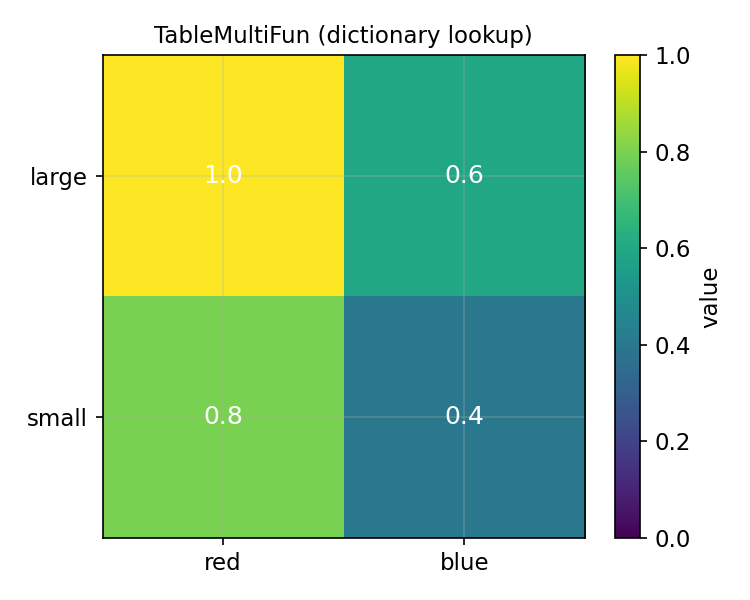
TableMultiFun
A dictionary lookup keyed by value tuples – the multi-issue equivalent of
TableFun.
from negmas.preferences.value_fun import TableMultiFun

f = TableMultiFun(
    mapping={
        ("red", "large"): 1.0,
        ("red", "small"): 0.8,
        ("blue", "large"): 0.6,
        ("blue", "small"): 0.4,
    }
)
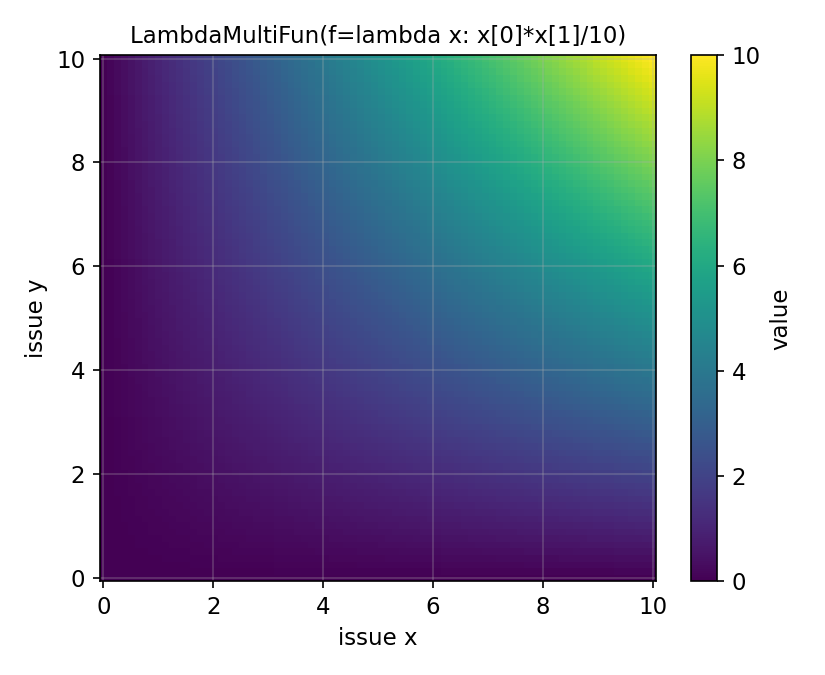
LambdaMultiFun
Wraps an arbitrary callable taking a value tuple: f(x) = g(x) + bias.
from negmas.preferences.value_fun import LambdaMultiFun

f = LambdaMultiFun(f=lambda x: x[0] * x[1] / 10.0)
Regenerating the figures
The images on this page are generated by
coding_agents/generate_value_fun_figures.py. Run it (from the repository
root) and re-render the docs whenever the plotted examples change:
python coding_agents/generate_value_fun_figures.py